Are Students Still Learning, or Just Getting Answers?

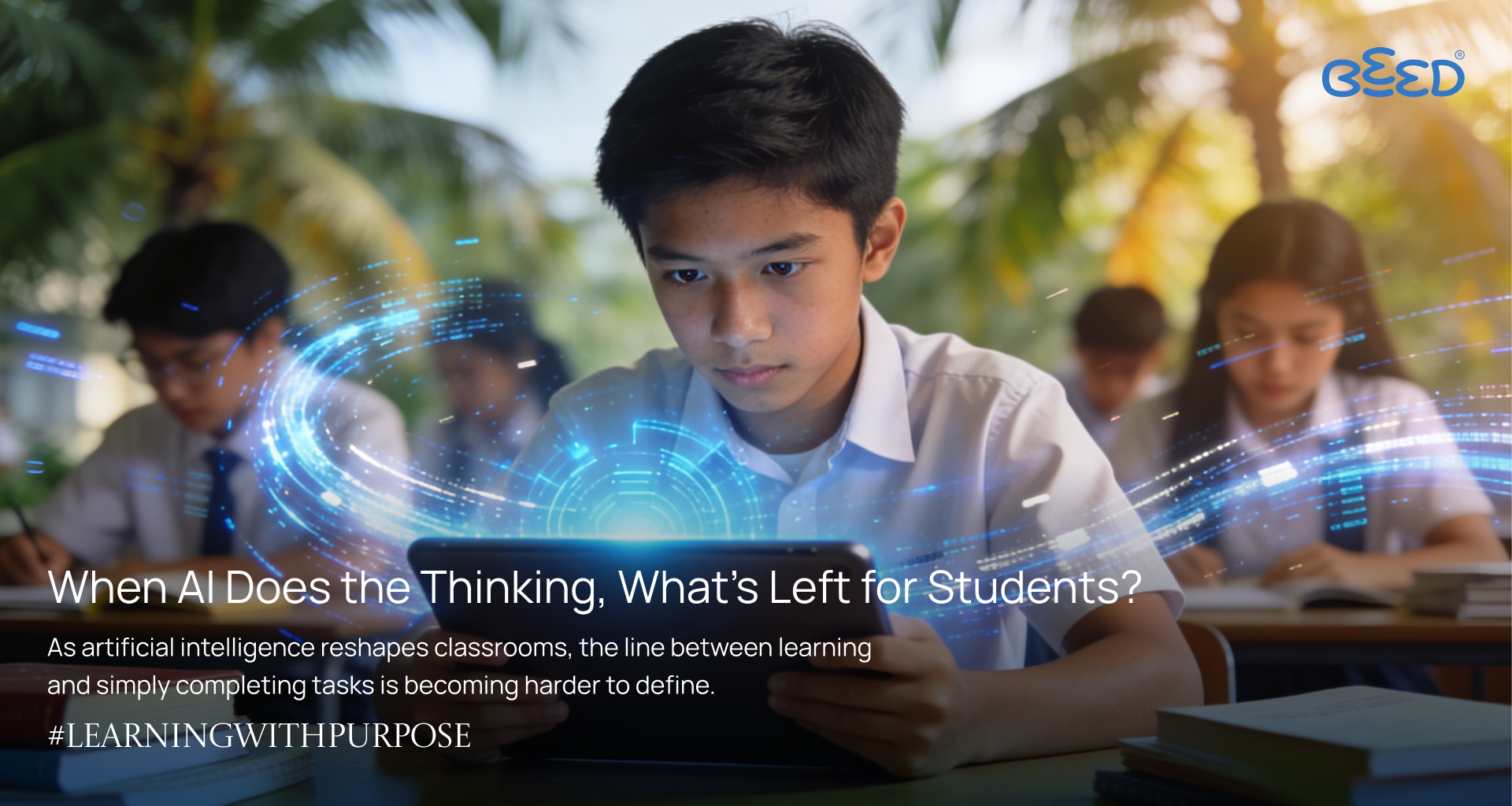
In a typical classroom, a student finishes an essay in minutes.
Not through understanding, but through artificial intelligence.
This is no longer unusual. It is becoming normal.
AI has quietly entered education, living in students’ pockets. It helps, accelerates, and simplifies. At the same time, it blurs a critical line: the difference between learning and completing tasks.
A Generation Shaped by AI
Research from the Pew Research Center shows that a growing number of teenagers rely on AI for schoolwork.
The benefit is clear. AI makes information accessible, explanations faster, and learning more personalised. Studies from the Brookings Institution highlight its potential to support inclusive and adaptive education.
But access is not the same as understanding.
When Thinking Becomes Optional
Concerns are growing that overreliance on AI may weaken critical thinking. The UK Parliament Office of Science and Technology warns that without guidance, AI can reduce cognitive effort in learning.
For adolescents, this matters more. They are still forming how they think, not just what they know.
If AI provides answers too quickly, the process of questioning, analysing, and struggling may slowly disappear.
The Ethical Grey Area
AI also challenges academic integrity.
At what point does assistance become substitution?
Research in the Asian Journal of Education and Social Studies suggests that AI complicates traditional definitions of cheating. Many students are aware of this ambiguity, as reflected in studies indexed by ScienceDirect.
The boundaries are no longer clear, and students are navigating them in real time.
Beyond the Classroom
The impact of AI is not only academic.
Studies from PubMed Central indicate links between AI use and adolescents’ social development. Meanwhile, researchers at Stanford University warn of potential emotional dependence on AI systems.
As AI becomes more responsive, it risks replacing not just effort, but interaction.
Tool or Substitute?
The real issue is not whether AI is helpful.
It is how it is used.
Without proper understanding, students may use AI passively. With the right guidance, however, AI can support deeper learning, confidence, and independence.
This is where AI literacy becomes essential.
The Role of Educators
Teachers are now more important than ever.
Their role is no longer just to deliver content, but to guide students in:
- using AI responsibly
- questioning its outputs
- maintaining independent thought
Without this, education risks becoming a system that produces answers rather than thinkers.
An Unfinished Question
AI will remain part of education.
The question is no longer whether students will use it, but how it will shape them.
Education has never been about how fast answers are found.
It has always been about how understanding is built.
Reference
- Vieriu, A. M. (2025). The Impact of Artificial Intelligence on Students' Learning
- Aung & Bauyot (2025). AI in Adolescent Learning: Academic Integrity and Critical Thinking
- Landesman, R. (2026). Teens’ Uses and Concerns About AI
- Xie, C. et al. (2022). AI in Education and Adolescents’ Social Adaptability
- Yang, H. (2025). Generative AI and Cognitive Engagement
- Pew Research Center (2026). How Teens Use and View AI
- UNESCO (2026). AI in Education Framework